


Do you want to improve your business and attract more customers or clients? Do you know who else is trying to attract them? Do you know which companies are similar to yours and target the same people? Most entrepreneurs do not know who their real competition is. Or if they do know, they do not use that knowledge as they should.
When people talk about competition, many think of a well known local craftsman, the largest company in the same industry, or an advertisement they have seen several times online.
Competition is not just someone who does the same work as you. Real competition is any offer that can pull your customer away from you. Sometimes it is not a similar company, but a completely different product or service that solves the same problem.
That is why it is important to explore who is competing for the same attention and money of your customers. Without a clear picture of this, you are actually making decisions based on assumptions, which rarely ends well.
Competitor analysis means reviewing and understanding other companies’ offers, prices, communication, visibility, and strengths and weaknesses.
The goal is not to copy others and do exactly what they do, but to understand what they offer, how they present themselves and their products or services, and how you can be better, faster, or clearer.
Data you should monitor:
All of this shows you where you stand compared to others and what your potential customers and clients actually see when they are looking for a solution to their problem.

For a competitor analysis, you need a clear analysis structure that you will apply every few months.
A good analysis starts with simple questions that you can use by changing the way you present your offer.
Start with the questions your customer or client would ask:
People usually do not carry out detailed research, but focus on what is most visible. This is exactly where an important part of the analysis lies.
Type the keywords that best describe your business into Google and look at the first search results and ads. This is your competition that people see first, regardless of whether they provide the best service. Visibility often beats quality.
Open their websites and social media profiles and note the following:
Review prices and terms:
When you review the offer, review the reviews as well. They reveal what companies rarely admit about themselves.
Analyze the reviews:
Once you have all the listed data, compare it with your own offer.
Only then does the real value of competitor analysis become clear, because only then do you see the difference between what you think you offer and what customers actually experience.
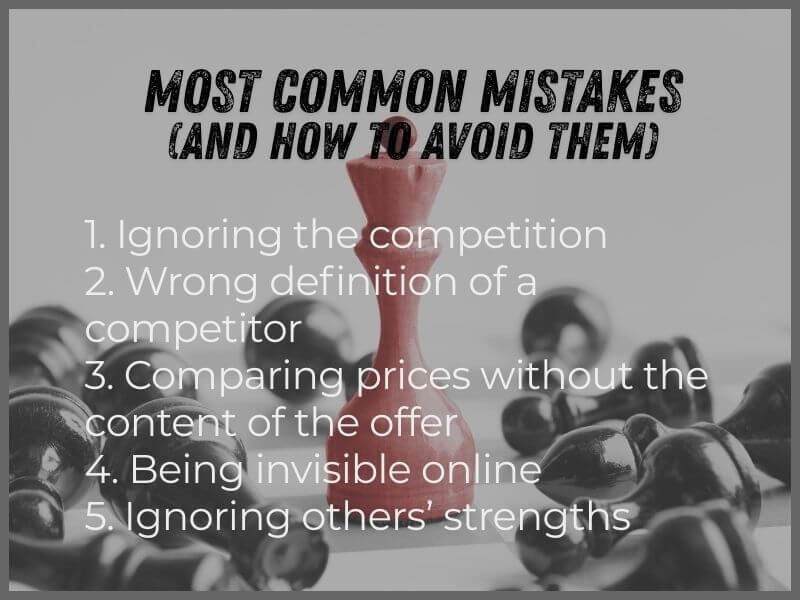
1. Ignoring the competition
Do not think that just because you have your own customers and clients, you do not need to pay attention to others.
Having them now does not mean they will stay with you. Competition does not rest. If you do not know who is taking your customers and clients, it will be hard to understand the drop in interest or fewer inquiries.
2. Wrong definition of a competitor
Do you think that if someone sells at a higher price, they are not your competition? Wrong.
If someone who charges more communicates more clearly, appears more reliable, or offers better customer support, the buyer will seriously consider that option. Price is not the deciding factor if you do not give a reason to be chosen.
3. Comparing prices without the content of the offer
If your website does not explain exactly what you do, who you do it for, and why it should matter to anyone, the price will not help. People are not looking for the cheapest option, they are looking for what appears to be a good choice.
4. Being invisible online
An offer that a customer cannot find or understand will not sell.
It is not enough to exist, you need to be available, clear, and present online, that is, where people are looking for answers.
5. Ignoring others’ strengths
Reviews of other companies are not there for nothing, use them.
If everyone mentions fast support, a simple process, or an accurate delivery time, these are signs of what the market values most. Do not ignore reviews, because they are an excellent opportunity to improve your own business.
What should you pay attention to if you want to be a better choice?
If all of that is in place, your customer or client knows where they have landed, what you offer, and why you are a good choice. If it is not, do not blame the market – start by fixing what you can.

There is no point in being a copy of someone else’s idea. Someone will always be cheaper, bigger, longer on the market, or better known.
If you try to be like everyone else, you will lose what makes you different. And it is exactly that difference that will attract the customers who are looking for what you have and the approach you offer.
People want to understand. If you do not explain exactly what you offer, how you work, and why they should choose you, they will not figure it out on their own. They do not need a lot, but they need clarity.
If you “keep an eye” on the competition, you will more easily:
Staying true to yourself means knowing what is happening around you and deliberately choosing how you will position yourself. And all of that with a clear message that speaks directly to the people you want to reach.
The market never stands still, and your customers and clients change their habits faster than it seems.
If you regularly monitor what is happening around you, you will recognize changes sooner, spot threats earlier, and more easily catch the right moment to adapt.
If you analyze the competition regularly, you will not make better decisions because you have more time or money, but because you are looking at the bigger picture. You know who your audience is, who your customers and clients are, what they all see when they search, and you know how to make their decision to purchase or order easier.
And if they choose your offer, it will not be by accident, but because you seem more reliable, clearer, and closer to their real needs.
If all of this sounds useful but you do not know where to start, contact us.
We work with companies that want to be more visible, communicate more clearly, and grow based on real data.

balamaU1.phtml